
GAMMIS Revalidation: Keep Georgia Medicaid Active
By George Ruan • October 9, 2026
Last reviewed: October 10, 2026.
Start Georgia Medicaid provider revalidation at the official GAMMIS portal. Check the notice and revalidation status for each enrolled service location. If you are looking for the overdue list, use GAMMIS Reports for Public Access, which identifies past-due service locations and directs providers to revalidate the listed location.
Need access help? Our GAMMIS login guide covers the portal entrypoint. This guide addresses keeping an existing enrollment current, rather than a first-time therapist enrollment application.
Sections
Is Georgia Medicaid revalidation every three or five years?
Georgia’s July 2026 Part 1 manual, section 105.15 says enrolled providers must revalidate at least every three years. DCH’s June 1, 2026 overdue-provider announcement cites the federal requirement of at least every five years. The federal floor does not extend a provider’s Georgia due date. Use the state notice and the relevant service-location record.
The current navigation manual, section 16.2 describes revalidation information and alerts for service locations. The March 2026 Group/Billing Enrollment FAQ also says groups must revalidate. Checking only one individual clinician is not enough to establish that every billing-group or location record is current.
What did the July 1, 2026 revalidation deadline mean?
The June DCH announcement addressed identified past-due providers. It described July 1 suspension and nonpayment for affected dates of service from July 1 forward, with consequences across FFS, Georgia Families, Georgia Families 360 and PeachCare for Kids. July 1 is now a past campaign date, not a new deadline for every provider reading this article.
The announcement says a completed revalidation can lift the suspension, but the enrollment effective date becomes the application submission date, without retroactive enrollment. It also describes termination notice and appeal rights when the affected provider does not complete the process within 30 days of the suspension letter. Read your actual letter before assuming those dates apply to your record.
DCH’s June 2026 revalidation strategy outlines phased overdue-provider suspensions in July, August and September, with later termination phases. A strategy or public list alone does not prove the current status of a particular provider. Check GAMMIS and the notices for the specific service location.
Submit the revalidation for the correct location
The public Provider Revalidation Process guide, June 2026 describes the portal application sequence. Use the current revalidation instructions and location-specific notice:
Confirm the application and service location
Confirm the service location and revalidation application. The guide shows Recredential/Revalidation in the provider navigation. A record for another office does not answer the listed office’s notice.

Screenshot source: Provider Revalidation Process, June 11, 2026, page 3; navigation crop.
Review the fields and attach the requested documents
Review the contract, specialty, location and disclosure sections; complete required fields. The guide says moving a practice address requires a Change of Information request. Upload the documents requested for that application.
Complete the attestation and submit
Read and complete the Statement of Participation attestation, then submit. The manual’s example below has sample names masked; its date is an example, not a new deadline.
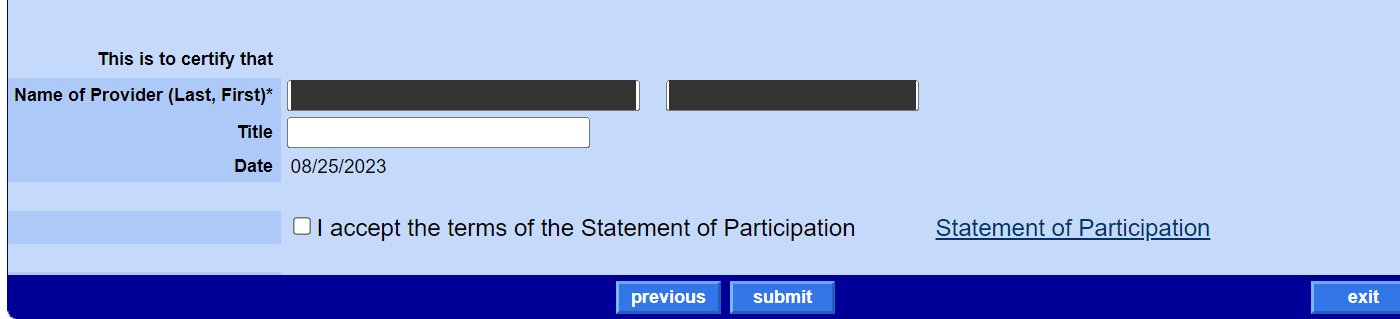
Screenshot source: Provider Revalidation Process, June 11, 2026, page 25; attestation controls crop.
Retain the submission result and tracking information
The guide shows IN-PROCESS after successful submission. Keep the confirmation and tracking information, and retain the ATN if you need to return to an unfinished application. The sample ATN and names are masked below.

Screenshot source: Provider Revalidation Process, June 11, 2026, page 27; submitted-status crop.
A saved ATN is not completed submission, and an IN-PROCESS status is not approval. Follow the application and any requests for additional information through the state’s decision rather than assuming a save button renewed the enrollment.
If claims stopped after a revalidation notice
Compare the affected service dates with the suspension letter, current provider/location status and any new effective date. DCH’s June announcement says the overdue campaign can affect CMO as well as FFS payment. Our Georgia therapy claims guide explains claim routing, but correcting a claim does not replace completing revalidation.
Use GAMMIS training and support resources for unresolved application questions, and preserve the correspondence and decision. For visits after a record is restored, recheck member eligibility and the relevant CMO participation records. State revalidation does not establish every other payment condition.
Frequently Asked Questions
How often do Georgia Medicaid providers revalidate?
The July 2026 Georgia Part 1 manual says at least every three years. The federal five-year minimum cited in DCH’s June announcement does not extend the Georgia schedule. Check the notice and GAMMIS record for each enrolled service location.
Where is the GAMMIS past-due revalidation list?
Use GAMMIS Reports for Public Access. The report identifies past-due service locations and directs providers to revalidate the listed location. Confirm the record and notice rather than treating the list as an approval or suspension-status decision.
Was July 1, 2026 a revalidation deadline for every Georgia provider?
The June announcement addressed identified past-due providers and described a July suspension campaign. It is a past campaign date, not a new universal deadline. Use your location’s actual due date and suspension letter.
Does saving an ATN complete GAMMIS revalidation?
No. The public revalidation walkthrough distinguishes an unfinished saved application from submission. Complete the requested documents and attestation, submit, retain the confirmation and follow the application through the state’s decision.
Can overdue revalidation affect CMO claims as well as FFS?
Yes. DCH’s June 2026 announcement describes consequences across FFS, Georgia Families, Georgia Families 360 and PeachCare for Kids for affected past-due providers. Check the provider’s own notice, service dates and current status.
Sources
Part 1 Medicaid/PeachCare for Kids, July 1, 2026
DCH Provider Revalidation Deadline, June 1, 2026
Georgia Medicaid Provider Revalidation Strategy, June 2026
GAMMIS Reports for Public Access
GAMMIS Provider Web Portal Navigational Manual v6.2, September 2026
Need help getting payer-ready?
For practices enrolled in Bomi Billing, our team handles CAQH, payer applications, attestations, roster updates, and ongoing credentialing. Credentialing requires Bomi Billing.
Credentialing with billing
About Bomi
Founded by George Ruan, Dax Earl, and Andrey Goder, Bomi helps independent therapists and group practices with insurance billing, credentialing, and payer follow-up. Bomi grew out of Dax’s experience helping his mother with her therapy practice, with a clear purpose: reduce the administrative burden of insurance while keeping practice owners in control.
Meet our founders