
Georgia Medicaid Therapy Claims and Telehealth
By George Ruan • October 9, 2026
Last reviewed: October 10, 2026.
For Georgia Medicaid behavioral health claims, start with the official GAMMIS portal and verify who covers the member on the service date. Then use the FFS or CMO claims route that applies. A telehealth visit also needs the service-specific coverage, authorization, place-of-service and modifier checks.
This guide uses the October 2026 Psychological and Therapy Services manual and Telehealth Guidance. Find later revisions in the official provider-manual catalogue before applying these rules to a later visit.
For portal access, use our GAMMIS login guide.
Sections
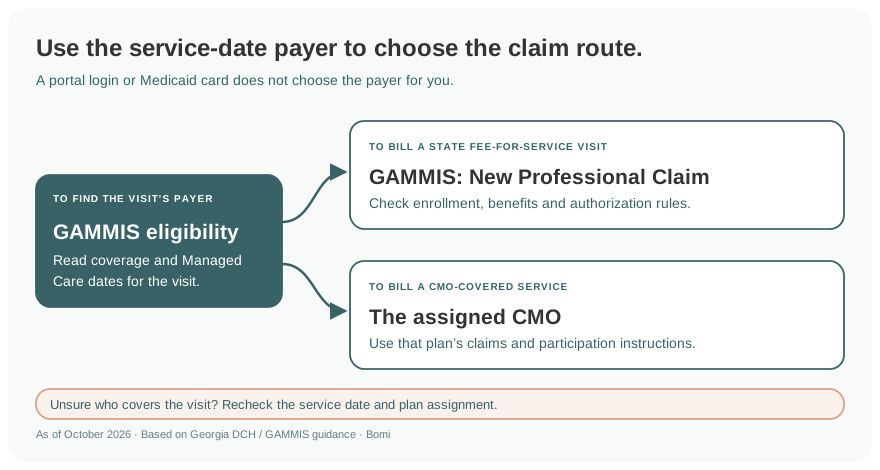
Choose the FFS or CMO claim destination
Use the member’s dated eligibility and managed-care response, as explained in our GAMMIS eligibility guide. For state fee-for-service professional claims, the GAMMIS navigation manual, section 11.5 describes Claims → New Professional Claim. The therapy manual identifies the CMS-1500 professional claim format.
For a CMO-covered service, use the applicable plan’s claims instructions. CareSource Georgia’s claims page describes submission and payment tracking through its provider portal. Amerigroup Georgia’s resources link its claims/disputes guidance, and Peach State’s behavioral health resources link its Medicaid manual and adjustment/appeal forms. DCH’s current CMO list is the plan-list reference; it is not a replacement for the member’s assignment.
Check the therapy program and authorization
Sections 701 and 902 of the Psychological and Therapy Services manual limit that program to members under 21. Section 902 describes 24 units per year without further authorization; services beyond the initial units require prior approval. Section 801 directs submission of the request 30 days before those initial units are exhausted.
Apply those limits to the program described in that manual. Do not use them as a universal limit for every CMO or behavioral health program, and do not infer that every adult Medicaid behavioral health service is excluded. Identify the actual benefit and check the relevant program or CMO policy.
Match billing and rendering records
The March 2026 Group/Billing Enrollment FAQ requires applicable group billing records and rendering affiliations. It says claims can deny when the rendering provider is not affiliated with the enrolled billing NPI. Verify the billing entity, rendering clinician, location and current taxonomies before interpreting the problem as a telehealth denial.
Our Georgia Medicaid therapist enrollment guide covers those records. Confirm the individual and group effective dates, too; Part 1 does not reimburse services before the approved enrollment effective date.
The navigation manual’s professional-claim example places Billing Provider ID, Billing Taxonomy, Rendering Provider ID and Rendering Taxonomy in the Billing Information panel. The sample provider identifiers are masked here. These are claim fields; their presence does not establish that enrollment or affiliations are approved.
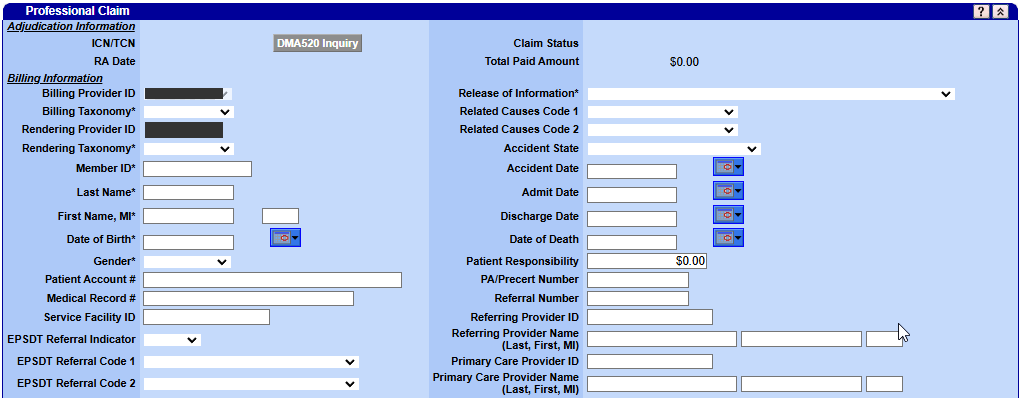
Screenshot source: Provider Web Portal Navigational Manual v6.2, September 2026, PDF page 102 (printed page 89); billing-fields crop.
GAMMIS telehealth: POS 02, POS 10 and modifiers
Section 605 of the October Telehealth Guidance directs providers to use the appropriate CPT/HCPCS code and discusses GT as applicable and/or telehealth place of service. POS 02 describes telehealth when the patient is somewhere other than home; POS 10 describes telehealth in the patient’s home. Match the actual patient setting.
The guidance also discusses modifier 93 for audio-only as appropriate. That does not make every telephone therapy service covered. Read the modality restrictions and program requirements alongside the billing instructions, and check the member’s CMO policy when applicable. There is no single modifier recipe in this guide for every Georgia therapy claim.
Section 607 requires written telehealth consent in the record. Review the guidance’s documentation and privacy requirements as well as the code fields; correct coding alone does not establish that the encounter meets all conditions.
The professional-claim detail example shows From DOS, To DOS, POS, Procedure and modifier fields. Enter codes that meet the service’s current program or CMO requirements; the blank fields below are not a recommended telehealth coding combination.
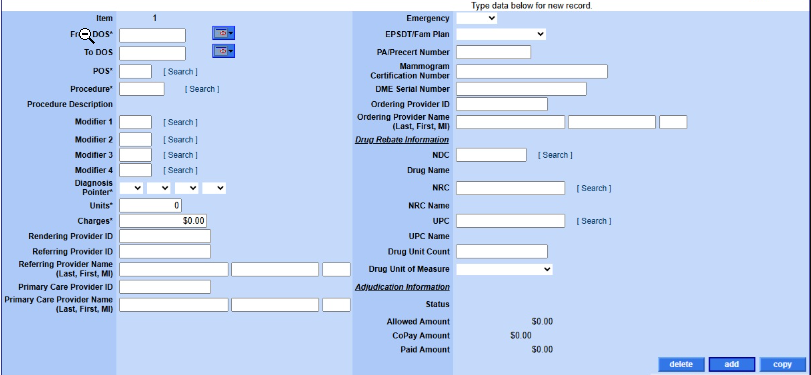
Screenshot source: Provider Web Portal Navigational Manual v6.2, September 2026, PDF page 103 (printed page 90); detail-fields crop.
After submission, read the status and remittance
The GAMMIS navigation manual describes an Internal Control Number (ICN) after a professional claim is submitted, followed by claim-status and remittance information. Retain the ICN for tracking. A submission confirmation is not a paid claim.
For a denial, compare the status or remittance reason with the dated eligibility response, authorization, billing/rendering records, service code, modifier and POS. Follow the responsible payer’s correction or appeal instructions and its filing rules. For a provider suspension, also check GAMMIS revalidation; a claim edit does not repair an inactive enrollment record. See CMO vs FFS participation if the payer route itself is uncertain.
Frequently Asked Questions
Do Georgia Medicaid therapy claims go to GAMMIS or the CMO?
Use the payer responsible for the service on the date of service. GAMMIS supports state FFS professional claims. For a CMO-covered service, follow that plan’s claims instructions after checking the member’s assignment and benefit.
What is the Georgia Medicaid therapy limit before prior authorization?
The October 2026 Psychological and Therapy Services manual describes 24 units per year in its under-21 program, with prior approval beyond the initial units. That is not a universal limit for every CMO or behavioral health program.
Should a Georgia Medicaid telehealth claim use POS 02 or POS 10?
The October 2026 state guidance describes POS 02 for telehealth when the patient is not at home and POS 10 when the patient is at home. Confirm service coverage and the applicable program or CMO coding instructions as well.
Does Georgia Medicaid cover all audio-only therapy with modifier 93?
No blanket coverage rule follows from that modifier. The state guidance mentions 93 as appropriate alongside modality and program restrictions. Check the actual service and the member’s plan before relying on audio-only coverage.
Does a GAMMIS ICN mean my claim has been paid?
No. The ICN identifies the submitted claim for tracking. Read the subsequent claim status and remittance to determine whether it was paid, suspended or denied and what action is needed.
Sources
GAMMIS Provider Manuals catalogue
Psychological and Therapy Services, October 1, 2026
Telehealth Guidance, October 1, 2026
Part 1 Medicaid/PeachCare for Kids, July 1, 2026
DCH Georgia Families official CMO list
GAMMIS Provider Web Portal Navigational Manual v6.2, September 2026
GAMMIS Group/Billing Enrollment FAQ v6, March 24, 2026
CareSource Georgia Medicaid claims
Want Bomi to handle insurance billing?
Bomi helps therapy practices with benefit checks, claims, denials, balances, CAQH, attestations, and revenue management.
Book a call
About Bomi
Founded by George Ruan, Dax Earl, and Andrey Goder, Bomi helps independent therapists and group practices with insurance billing, credentialing, and payer follow-up. Bomi grew out of Dax’s experience helping his mother with her therapy practice, with a clear purpose: reduce the administrative burden of insurance while keeping practice owners in control.
Meet our founders