
LifeWise Individual Plans: InstaMed EFT and Paper Checks
By George Ruan • October 9, 2026
As of October 9, 2026. LifeWise’s electronic-payments page separates individual plans from group plans. Individual-plan EFT uses InstaMed; the group-plan instructions point to Availity. Choose the correct tab before following enrollment steps. Official payment instructions.
Open InstaMed provider ERA/EFT enrollment for a new payer-payment account, or InstaMed Online for Providers for an existing account. Confirm the product limits below before applying.
Sections
Which payments use this route?
For individual plans, LifeWise says an existing InstaMed account receives EFT automatically and directs new users to instamed.com/eraeft. Confirm that the billing entity on the payment matches your account; an account under another tax ID is not enough to establish this payment’s routing. Check the payer instructions.
Card fees, checks and no-fee EFT
LifeWise asks providers to check that billing NPI2 information is current and matches the correct TIN. Its March 2024 paper-check notice also documented cross-system NPI/TIN problems that providers could not resolve themselves at that time. That historical notice is not proof that your current issue has the same cause. Review the source before choosing a method.
The older paper-check notice described an unresolved cross-system issue, not a guaranteed self-service correction. LifeWise’s March 2024 notice.
How to enroll and keep remittances connected
Open the individual-plans tab. Follow LifeWise’s InstaMed online registration link, or the paper-form route on the same page. Use the group-plan instructions only for a group-plan payment. Official instructions.
Check the billing identity. Review the billing NPI2 and TIN in your InstaMed account. Ask LifeWise to confirm its records if a payment still arrives by check; do not assume your screen and the payer’s data are aligned. Official instructions.
Plan for electronic remittances. LifeWise warns that EFT enrollment turns off paper EOPs for the Premera business entities and affiliates covered by its instructions. Confirm where your team will retrieve those EOPs before relying on mail. Official instructions.
Enter the practice information
The 2026 Brown & Toland provider manual illustrates InstaMed’s business-information screen: legal business name, address, principal or officer details, and billing provider information. Use the practice’s records and follow the current application prompts. These are shared InstaMed registration illustrations, not this payer’s claim portal. The manual was revised September 2025; screens may change. Enrollment screen guide.
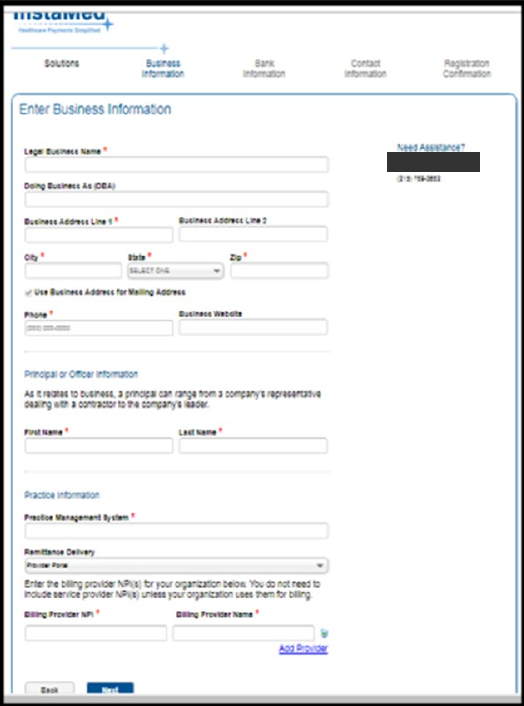
Screenshot source: Brown & Toland Provider Manual 2026 (revised September 2025), page 29.
Enter the bank account for EFT
The next illustrated enrollment screen asks for the bank name, routing number, account number and account-number confirmation. Enter the practice’s intended deposit account and follow the current verification requirements. The example check and contact address in the crop are covered. Bank-information screen guide.
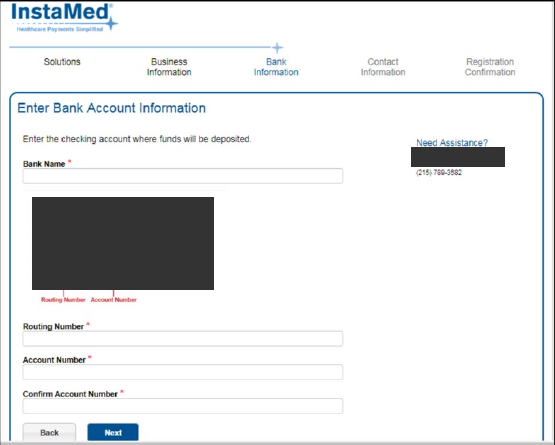
Screenshot source: Brown & Toland Provider Manual 2026 (revised September 2025), page 29.
InstaMed’s application permits only the owner or an authorized employee to complete registration; third-party enrollment is not allowed. Your biller can help prepare records and use separate delegated access after setup. Registration terms.
Verify the first payment
As an operational check, compare the bank deposit with the corresponding ERA or EOP, confirm the billing entity and payment reference, and check that your billing system received the remittance. InstaMed provides portal remittance access and a supported-clearinghouse list. ERA and remittance overview; supported ERA clearinghouses.
If enrollment or a payment is still missing
Recommended next check: If a paper check continues, compare the payer’s current explanation with the older LifeWise notice rather than repeating account edits indefinitely. In March 2024, LifeWise described missing or mismatched NPI data and multiple-TIN issues and said no provider action was available then. Ask for the current status of your billing entity. Payer payment guidance; InstaMed provider support.
What if a fee was already taken?
Keep the remittance, merchant settlement or vendor statement, and enrollment confirmation. Ask the entity that actually charged the fee about its refund policy and ask the payer/vendor to confirm the method for future payments. Do not assume that a new enrollment reverses an earlier fee, or that a smaller settlement means the payer owes another full payment. For the general card-versus-ACH distinction, read the InstaMed virtual-card fee guide.
Get help with payment setup
Bomi can help your practice review payment notices, prepare enrollment details and check remittance delivery. The practice remains responsible for the owner/authorized-employee application. See Bomi billing support and the separate InstaMed user-access guide.
Related payer payment guides
InstaMed fee and ACH enrollment hub · Dean Health Plan InstaMed EFT/ERA: Check Your Payer ID
Frequently Asked Questions
Does LifeWise group-plan EFT use InstaMed?
The current LifeWise page separates routes: InstaMed for individual plans and Availity Transaction Enrollment for group plans.
Where is the LifeWise InstaMed registration link?
It is on the individual-plans tab of LifeWise’s electronic-payments page and points to instamed.com/eraeft.
Can I fix every paper-check issue in InstaMed?
No such guarantee is supported. LifeWise has documented cross-system problems that were not fixable by a provider at the time; ask about your current NPI/TIN record.
Sources
Growing a group practice?
Bomi helps coordinate insurance operations across providers, payers, rosters, claims, denials, and reporting.
See group support
About Bomi
Founded by George Ruan, Dax Earl, and Andrey Goder, Bomi helps independent therapists and group practices with insurance billing, credentialing, and payer follow-up. Bomi grew out of Dax’s experience helping his mother with her therapy practice, with a clear purpose: reduce the administrative burden of insurance while keeping practice owners in control.
Meet our founders