
NC Medicaid Enrollment for Therapists in NCTracks
By George Ruan • October 9, 2026
Last updated: October 9, 2026.
North Carolina therapists apply through NCTracks provider enrollment. As of October 9, 2026, NCTracks remains the state enrollment route. Approval of an individual or group record and participation in a health plan's network are separate milestones; track both before treating a new enrollment as ready for billing.
Sections
Which therapist licenses can enroll?
Clinical Coverage Policy 8C, section 6.1, includes LCMHCs, LCSWs, LMFTs, licensed psychologists and licensed psychological associates, along with the listed associate categories. It requires each licensed professional to be directly enrolled with their own Medicaid provider number and NPI; another clinician's enrollment does not substitute for their own.
Associates should check the policy and their licensing board's conditions for their exact license and service. Being listed in a coverage policy does not remove supervision or scope-of-practice requirements. Build the application around the actual license held, rather than selecting a fully licensed category because it appears similar.
Choose the taxonomy and enrollment classification
Use the live Provider Permission Matrix entry point and its August 16, 2026 workbook. It separates individual and organizational providers and lists requirements by taxonomy and program. Mental-health counselors, clinical social workers, marriage and family therapists, and psychologists appear in different categories; use the row that fits the applicant.
NC Medicaid's March 2026 provider-record bulletin explains that the matrix governs screening details such as licensure, accreditation, site visits, fingerprints and fees. These are classification-specific. Do not copy a behavioral health organization's checklist onto every individual LCSW or LCMHC application.
In an individual application, the Taxonomy Classification screen asks for Provider Type, Classification and Area of Specialization. Select entries that match the therapist’s actual license and the current matrix, then Add the taxonomy. The crop shows only those controls, not the guide’s unrelated example taxonomy. Individual enrollment guide
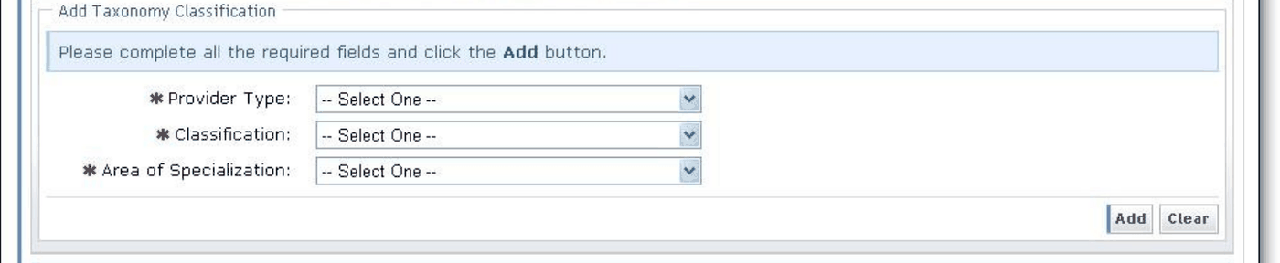
Screenshot source: How to Enroll in NC Medicaid — Individual, V2.0, August 6, 2025, PDF page 28 (printed page 22).
Prepare the individual and group records
Before opening the application, reconcile the therapist's full legal name with government identification, NPPES and the relevant licensing or credentialing records. NC Medicaid warns that mismatched names and incorrect taxonomies can disrupt enrollment and participation. Keep the actual supporting records available so the application reflects the same identity.
If a group will bill, plan the organization's enrollment as well as each rendering clinician's enrollment. For an already enrolled clinician joining a group or adding a site, use our NCTracks service-location and affiliation MCR guide. It explains when a full MCR is needed; the abbreviated affiliation option does not automatically add the group's location to the individual record.
Organizations should also review the September 2026 behavioral health enrollment update. Its requirements for organizational taxonomy 251S00000X are a separate review from the individual therapist's license category.
Submit through NCTracks and monitor requests
On Online Provider Enrollment Application, enter the service-location ZIP code and choose the enrollment application type for the applicant. The guide distinguishes Individual Full Enrollment from Organization Full Enrollment and Billing Agent enrollment; use the appropriate record rather than enrolling a clinician as the billing company. Individual application guide
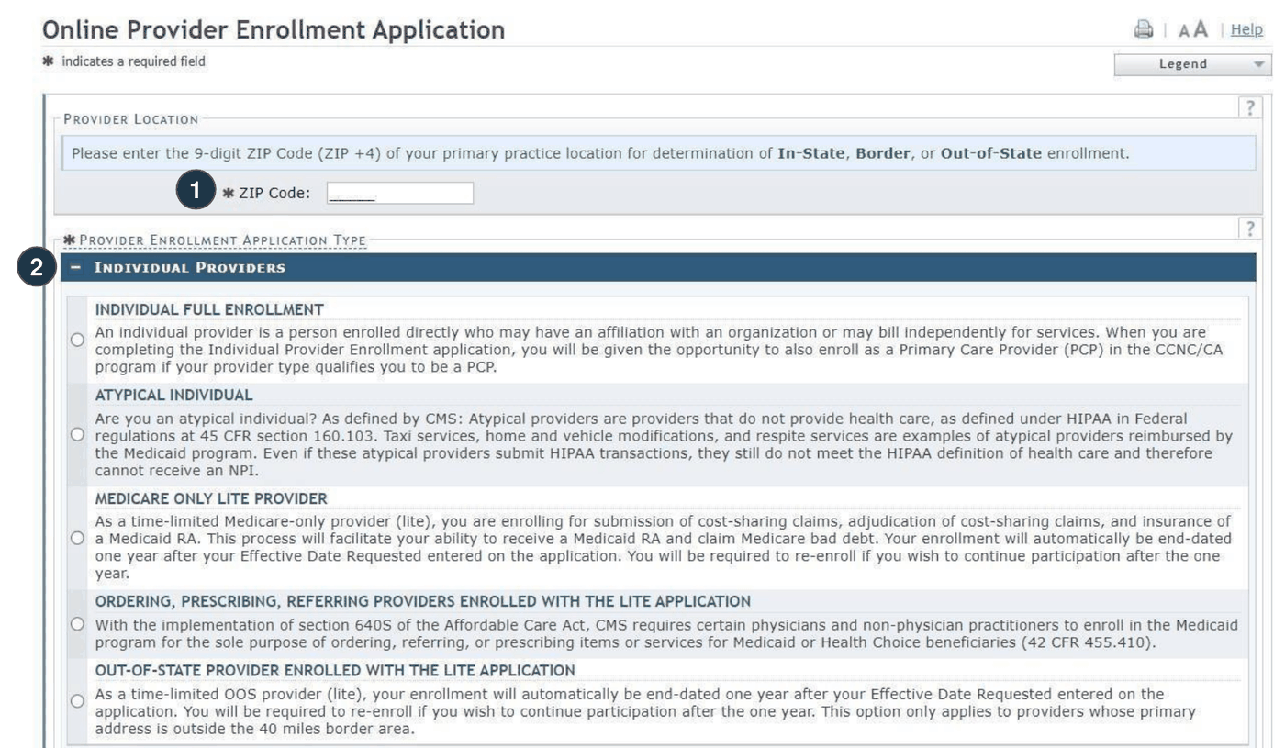
Screenshot source: How to Enroll in NC Medicaid — Individual, V2.0, August 6, 2025, PDF page 15 (printed page 9).
Follow the state's enrollment application instructions for the online application and supporting uploads. Use the appropriate individual or organization record, review the information and complete the required submission steps. Save the application reference and monitor requests for additional information rather than assuming a saved draft is submitted.
The PDM/CVO hold bulletin says providers must continue using NCTracks and monitor the Provider Message Inbox for action notices. Older articles announcing a new credentialing system's 2026 launch should not send you to a replacement enrollment portal.
Confirm approval before moving to plan contracting
Keep the approval notice, effective dates, enrolled taxonomies, service locations and group affiliations together for the billing team. Then review Standard Plans, Tailored Plans and Medicaid Direct contracting; an NCTracks enrollment does not automatically establish every network agreement.
If the enrollment contact cannot see the record, start with NCID and portal access. Once enrollment and the applicable network arrangement are confirmed, check eligibility for the actual service date and the payer's claim requirements.
Frequently Asked Questions
Can LCMHCs, LCSWs, LMFTs and psychologists enroll in NC Medicaid?
Policy 8C lists these professional categories. Choose the enrollment classification and taxonomy for the actual license, and check the current Provider Permission Matrix and applicable licensing conditions.
Does the group enrollment cover every therapist?
Each licensed professional must have their own enrollment under Policy 8C. Check individual enrollment, organization enrollment, affiliation and service-location records separately.
Does NCTracks approval put me in every Medicaid plan network?
No. Confirm the applicable plan contract and effective dates separately from NCTracks enrollment and state credential verification.
Growing a group practice?
Bomi helps coordinate insurance operations across providers, payers, rosters, claims, denials, and reporting.
See group support
About Bomi
Founded by George Ruan, Dax Earl, and Andrey Goder, Bomi helps independent therapists and group practices with insurance billing, credentialing, and payer follow-up. Bomi grew out of Dax’s experience helping his mother with her therapy practice, with a clear purpose: reduce the administrative burden of insurance while keeping practice owners in control.
Meet our founders