
NPI 1 vs. NPI 2: Groups, Rosters, and Self-Pay
By Dax Earl • October 14, 2026
A practice owner hires another fully licensed therapist. That therapist wants to accept insurance. The owner wants to focus on self-pay services. Does the owner still need to stay credentialed? Can the practice keep its insurance contracts if the owner steps off the roster?
To answer those questions, it helps to separate two identities: the person providing care and the organization operating the practice. Then we need to separate three processes: contracting, credentialing, and linking clinicians to the group.
The person, the practice, and the connection: NPI 1 identifies the individual provider. NPI 2 identifies the organization. Each payer separately determines the contract, qualifications review, and affiliations needed for network participation.
Sections
Two identities, two lanes
An individual clinician and a healthcare organization have different identifiers. A useful analogy is the distinction between a person’s SSN and a business’s EIN:
The clinician: a Type 1 NPI identifies the individual healthcare provider. An SSN is a familiar example of a personal tax identifier.
The organization: a Type 2 NPI identifies an organization healthcare provider, such as a group practice. An EIN is commonly called the business tax ID.
One clinician can have a Type 1 NPI while their separately organized practice has a Type 2 NPI—even if that organization employs only that clinician. CMS explains the two provider categories.
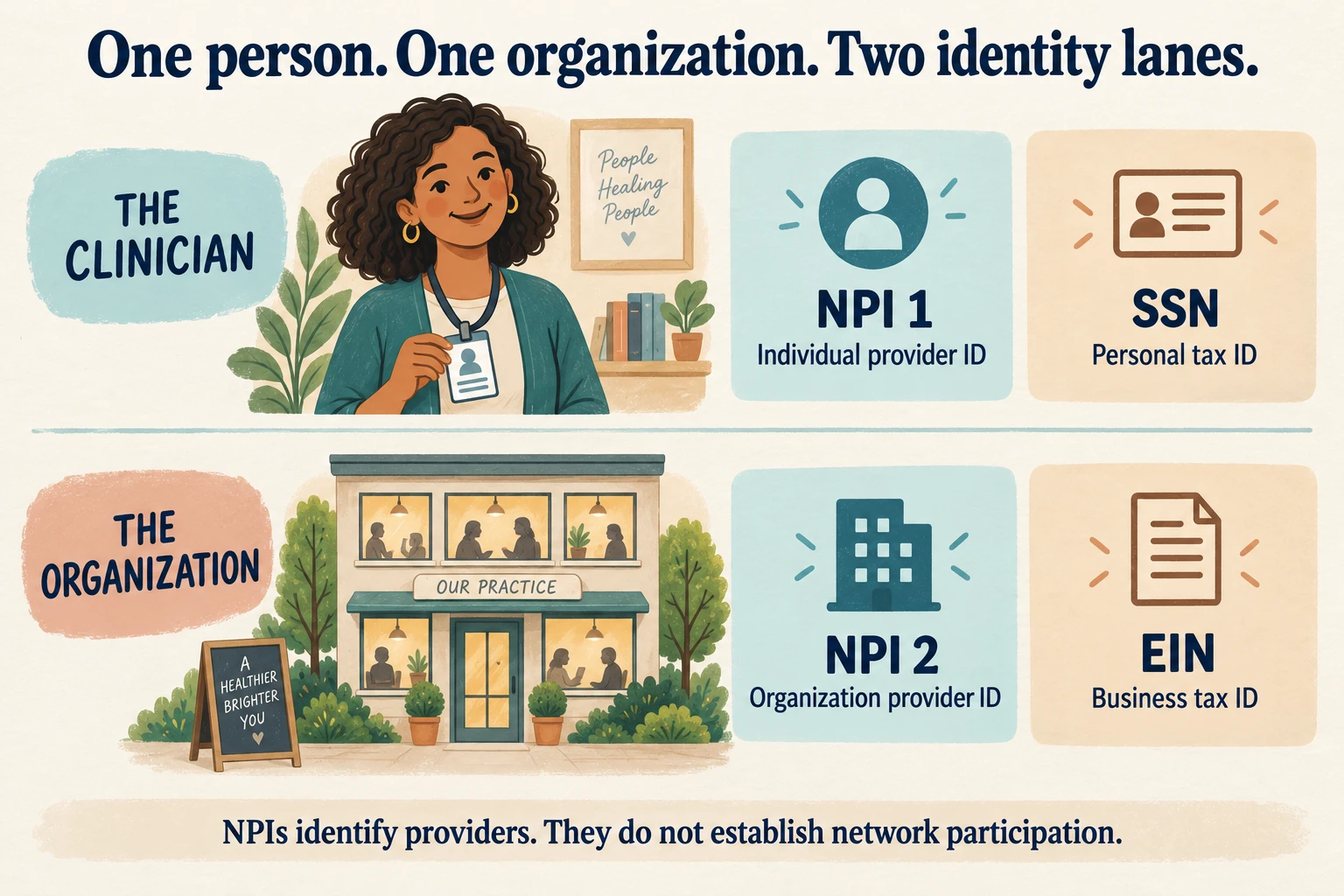
The analogy separates the person from the organization. NPI and tax identifiers serve different purposes and are not interchangeable.
NPIs identify healthcare providers; tax identifiers support tax administration. An NPI does not replace a tax ID. CMS’s identifier overview describes those separate roles.
A sole proprietor can have an EIN and still use a Type 1 NPI. Having an EIN does not automatically make a practice eligible for a Type 2 NPI. “Solo practitioner” describes how many clinicians practice; “sole proprietor” describes a business structure. CMS’s sole-proprietor explanation makes that distinction explicit.
Where NPIs came from
The NPI system grew out of the administrative simplification provisions of HIPAA, the Health Insurance Portability and Accountability Act of 1996. The goal was to standardize provider identification in electronic healthcare transactions. The final rule establishing the NPI was published on January 23, 2004. CMS’s NPI educational resources explain this history.
Implementation began in May 2005. The general compliance deadline was May 23, 2007, with an additional year for small health plans. CMS’s implementation history sets out those dates.
An NPI answers an identification question. Receiving one does not establish that a provider is licensed, credentialed, or participating in an insurance network. CMS’s NPPES notice explicitly cautions that issuing an NPI does not validate licensure or credentialing.
Three processes connect the practice to insurance
People often use “credentialing” to describe the entire process of joining an insurance network. For a group practice, separating the business agreement, the qualifications review, and the affiliation makes it easier to see what is complete and what is still missing. Payers may bundle these steps or process them in a different order.
1. Contracting: the business agreement
The contract establishes the practice’s relationship with a payer, including reimbursement terms and participation obligations. Think of this as the financial and business part of the relationship. Aetna’s network FAQs distinguish contracting from credentialing.
2. Credentialing: the qualifications review
Credentialing evaluates whether a clinician meets the payer’s professional requirements. Organizations and facilities may also undergo their own review, depending on their provider type and the payer’s process. Think of this as the clinical qualifications part.
A fully licensed therapist still needs to meet the applicable payer requirements. For example, Optum says that providers in non-delegated groups must be individually credentialed. Optum’s group guidance describes that requirement.
3. Linking or rostering: connecting the clinician to this group
The payer needs to recognize the individual provider’s affiliation with the practice. Jefferson Health Plans, for example, requests the group NPI, individual NPI, tax ID, address, and effective date when linking an already participating provider. Jefferson’s linkage requirements show why individual approval and group affiliation are separate.
These are three distinct questions: Does the practice have an agreement? Has the clinician been approved? Is that clinician connected to this practice under the relevant arrangement? Confirm the payer’s approval and effective date for the specific affiliation before treating it as active.
Think of the practice as a house
Imagine the organization is a house. Its Type 2 NPI identifies the house. The clinicians are the people working inside it, and each brings their own Type 1 NPI.
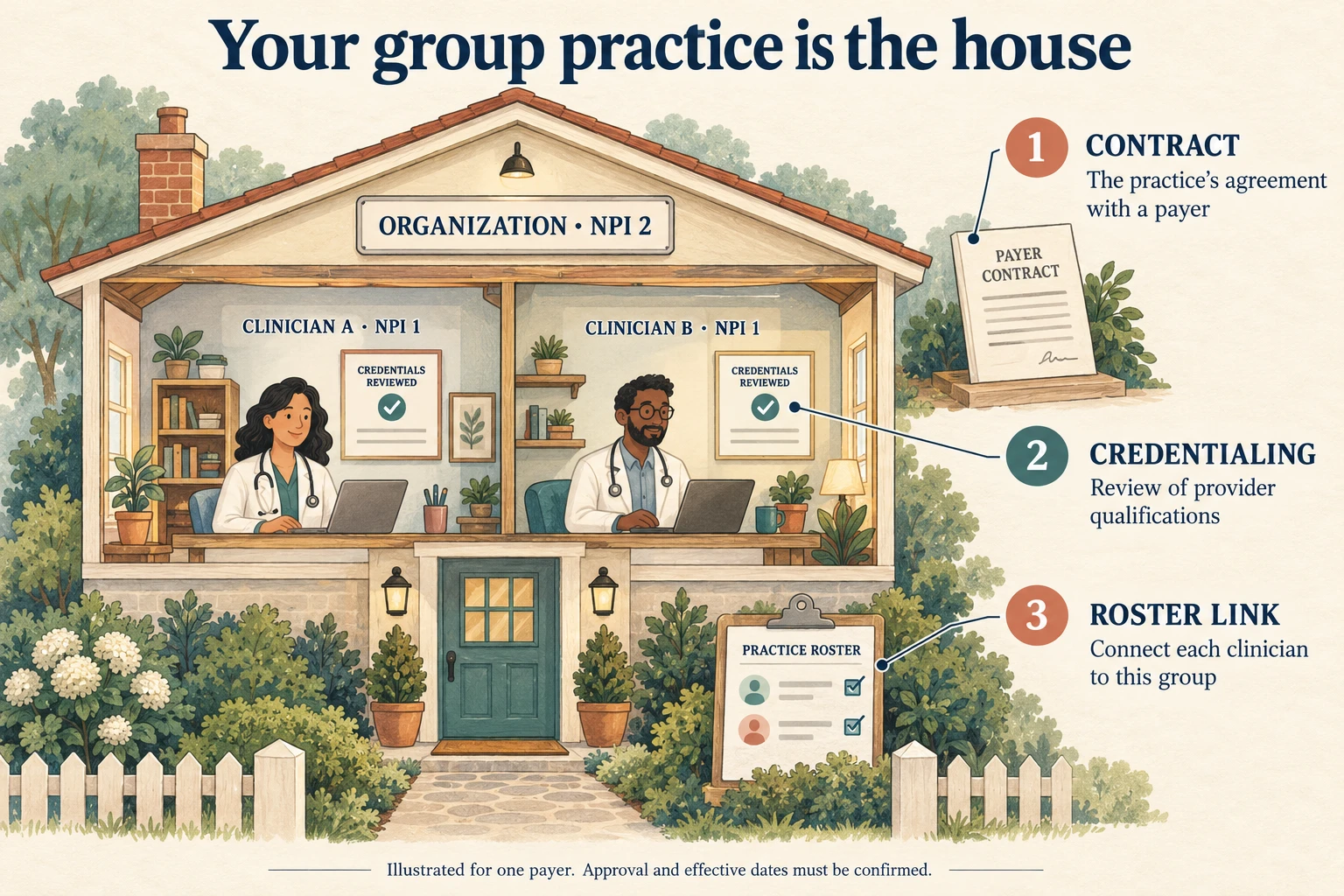
The payer contract is the house’s agreement with an insurance company. Credentialing checks the qualifications of the people who will provide care. The roster records which clinicians are affiliated with that house for that payer.
Giving someone a room does not finish their insurance setup. Their qualifications and affiliation still need to meet the payer’s requirements. Likewise, someone approved elsewhere may need a new affiliation established when they join your practice.
The rooms represent affiliations, rather than literal offices. The illustration shows one payer’s arrangement; a clinician working remotely still needs the appropriate payer setup.
Can the owner move toward self-pay while the group accepts insurance?
Now return to the owner’s question. The NPI distinction helps frame it, but NPI type alone cannot determine whether the arrangement is allowed.
Ownership, treating patients, and supervising other clinicians are different roles. Another clinician’s full license does not, by itself, resolve the owner’s participation requirements. Establish which roles the owner will keep, then check the actual agreement and payer rules:
Will the owner continue treating patients through the group?
Does the payer require all eligible clinicians in the group to participate?
Does the owner supervise clinicians whose billing depends on that supervisor’s participation?
What happens to the group agreement if the owner’s participation ends?
These contract questions matter. Optum’s published criteria for groups with individually credentialed providers require all eligible clinicians to agree to participate. A mixed insurance/self-pay arrangement cannot be assumed to work simply because clinicians have different Type 1 NPIs. Read Optum’s group criteria.
Supervision can introduce another dependency. Under Aetna’s published behavioral health supervisory-billing standards, a qualified supervisor must be independently licensed and actively credentialed and contracted with Aetna. An owner filling that role has a different situation from an owner whose work is entirely administrative. Aetna’s supervisory-billing guidance explains those conditions.
Ask each payer: “Can our group remain participating if this owner stops participating as a treating clinician? Which contract, roster, and supervision requirements would apply?”
Be precise about the requested change: removing one clinician and terminating the group’s payer contract are different actions. Obtain written confirmation of the intended scope and effective dates.
Self-pay is a separate decision from having an NPI
Moving toward self-pay does not, by itself, mean a clinician needs a different NPI. The identifier belongs to the provider; network participation is a separate relationship. CMS’s NPI guide explains that the NPI itself does not enroll a provider in a health plan.
Leaving a network and offering a particular service that insurance does not cover are also different situations. Identify which change you intend to make and review the relevant agreement before changing how patients pay. A self-pay label does not resolve a contract’s billing or participation obligations.
For uninsured patients and patients choosing not to use insurance, federal good-faith-estimate requirements generally apply when care is scheduled or an estimate is requested. CMS’s good-faith-estimate guidance explains the requirements. Our good faith estimate guide for therapists covers the practice workflow.
Medicare has its own private-contracting and opt-out rules for eligible practitioners. A general decision to become self-pay does not replace those steps. CMS’s Medicare enrollment guidance describes the separate process.
When planning a change, draw the house first. Identify the organization, the clinicians inside it, the contracts attached to it, and each clinician’s payer affiliations. That gives you a concrete way to ask what can change and what must be confirmed before it does.
Related reading
Frequently Asked Questions
What is the difference between NPI 1 and NPI 2?
A Type 1 NPI identifies an individual healthcare provider. A Type 2 NPI identifies an organization healthcare provider, such as a group practice. Neither number establishes licensure, payer credentialing, or network participation.
Does having an EIN mean I need an NPI Type 2?
An EIN alone does not determine NPI type. A sole proprietor can have an EIN while remaining a Type 1 provider. A separately organized healthcare provider may need its own Type 2 NPI even when it employs only one clinician.
Does a group contract automatically cover every clinician?
Do not assume it does. Confirm the payer’s qualifications review, group-affiliation requirements, approved locations and products, and effective dates for each clinician. Payer requirements and delegated credentialing arrangements vary.
Can the owner be self-pay while another therapist accepts insurance?
It depends on the payer agreement and the owner’s treating and supervisory roles. Some group arrangements require all eligible clinicians to participate. Another clinician’s full license alone does not settle whether the owner can leave the roster while the group remains participating.
Do I need a new NPI when I stop accepting insurance?
Moving to self-pay does not, by itself, require a different NPI. Network participation is separate from provider identification. Confirm contract termination, patient transition, good-faith-estimate requirements, and any applicable Medicare private-contracting rules before making the change.
Growing a group practice?
Bomi helps coordinate insurance operations across providers, payers, rosters, claims, denials, and reporting.
See group support
About Bomi
Founded by George Ruan, Dax Earl, and Andrey Goder, Bomi helps independent therapists and group practices with insurance billing, credentialing, and payer follow-up. Bomi grew out of Dax’s experience helping his mother with her therapy practice, with a clear purpose: reduce the administrative burden of insurance while keeping practice owners in control.
Meet our founders